
Down in Duvets and Pillows: Feathers, Origin, and Care
Down comes from the plumage of geese and ducks and, unlike feathers, has no quill: it is softer, lighter, and provides better insulation. Certifications such as RDS or Downpass guarantee the origin of the down, whereas the phrase “from dead animals” alone does not. According to Öko-Test, people who sweat a lot are better off opting for other materials.

Down as a comforter and as a pillow
| Feature | 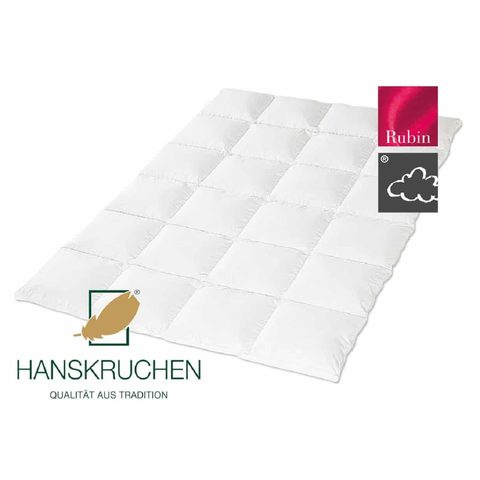 Rubin Down Comforter | 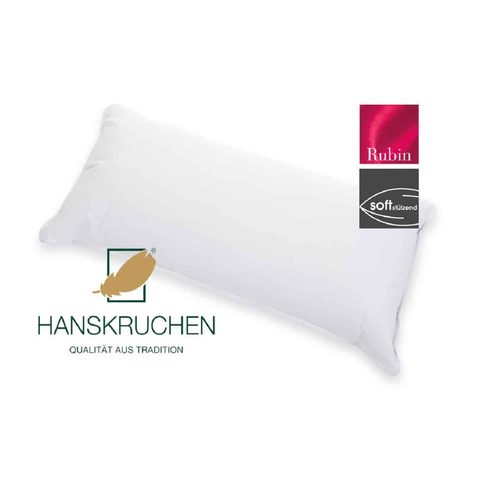 Ruby Pillow |
|---|---|---|
| What It Is | Goose or duck feathers | |
| Filling | Goose down | 85% duck down, 15% duck feathers |
| Cover | Batiste, 100% cotton | Cotton twill |
| Is there a | All-season blanket, normal warmth rating | Soft type, three chambers |
| Care | 60 °C, machine-dryable | 60 °C, machine-dryable |
| Sizes | 160 × 210 and 200 × 210 cm | 50 × 70 and 65 × 65 cm |
| In the Store | View the Rubin Down Comforter | View the "Rubin" Pillow |
To go with it

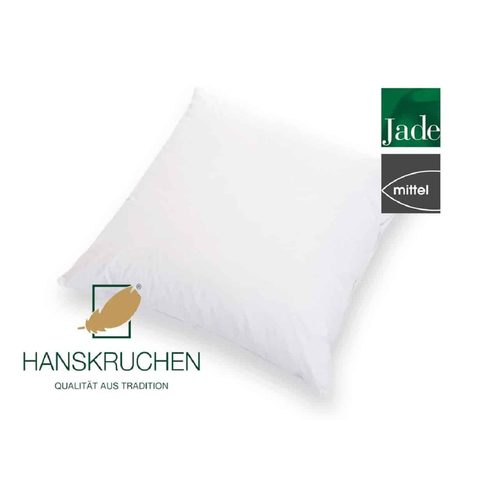
Jade Pillow
A feather pillow by Hans Kruchen: 15% down and 85% duck feathers, medium fill, machine washable at 60 °C and dryer-safe.
View PillowsPlume Organic Down Pillow
From Traumina: 90% German organic goose down and 10% feathers; according to the product page, GOTS-certified, washable at 60 °C, and dryer-safe.
View Pillows
Down or Feathers: What's the Difference?
The quill. Down has no quill and no shaft; it is softer and lighter than feathers and, according to Stiftung Warentest, provides better insulation. Feathers give a filling structure: According to Öko-Test, pure down flattens very quickly, while a blend of down and feathers offers more resistance.
The label tells you what’s in the filling. According to the DIN EN 12934 standard, it lists the proportions as percentages, such as 90/10 or 15/85: 90/10 means 90% down and 10% feathers. According to EN standards, a filling can be called a down product if it contains at least 60% down. Here’s how the four products in the shop are filled, according to their product pages:
- Rubin Down Comforter: Goose down, 100% according to the brief description. The page does not specify the composition according to the standard, nor does it mention a specific grade or fill weight.
- Rubin Pillow: 85% duck down and 15% duck feathers in three chambers—the outer chambers filled with down, the inner chamber with feathers and air-cell rods.
- Jade Pillow: 15% down and 85% duck feathers. With such a low down content, it is not classified as a down product according to EN standards; the product page refers to it as a feather pillow in one place and a down pillow in another.
- Plume Organic Down Pillow: 90% German organic goose down and 10% feathers; as a three-chamber pillow, the interior consists of 80% feathers and 20% down, depending on the model.
What a test found: In some of the ten down comforters tested by Stiftung Warentest in 2020, the filling did not match the information listed on the product.
Building Power: What Does It Tell Us About Heat?
It measures how much space down fills: According to the EN 12130 standard, where it is referred to as “fill power,” 30 g is used for this measurement. Compare two values only if they were measured in the same way, because, according to the IDFL testing laboratory, units can only be converted approximately, and types of pretreatment cannot be converted at all.
More down, more loft: In a test conducted by the Hong Kong Consumer Council, down comforters with a higher down content generally had greater fill power and provided more warmth. According to Öko-Test, how warm a comforter keeps you depends primarily on the air it traps—whether between feathers, wool, or polyester—and no one material is fundamentally superior to another.
For the Rubin down comforter, the product page does not list the fill power or fill weight, but instead specifies the warmth class as “normal” and a recommended bedroom temperature range of 16 to 18 °C. According to Stiftung Warentest, warmth classes are not uniformly defined. A new down comforter may provide even better warmth after two or three nights: heat and moisture cause the compressed down to fluff up again.
Here’s what the measurements show: Of the 18 blankets tested at the Hohenstein Institute, the two heaviest down blankets—weighing 1.75 and 1.77 kg—provided the best insulation in the temperature range the institute classifies as “winter.” A lightweight down comforter with 90% down, weighing 1.18 kg, provided less insulation than a polyester comforter weighing 1.32 kg. The weights include the cover.
Where does the down come from, and are geese plucked while they're still alive?
It cannot be ruled out entirely. According to the European Food Safety Authority (EFSA), the only pain-free method for live geese is combing out mature feathers during molting. Under current commercial conditions, however, it cannot be ruled out that feathers are also plucked, causing pain and bleeding. The RDS and Downpass labels prohibit any harvesting of down and feathers from live animals, as well as stuffing.
In Switzerland, the Animal Welfare Ordinance prohibits the live plucking or force-feeding of domestic poultry. However, down for bedding is imported: According to *Kassensturz*, 500 metric tons of down and feathers entered Switzerland in 2016, almost all of it for bedding, mostly from Poland, Hungary, Russia, Ukraine, and France. Therefore, look for a certified source, such as RDS. What the labels mean:
- Responsible Down Standard (RDS): Collecting down during the molting season is also prohibited. Independent auditors monitor every stage, from the farm to the finished product.
- Downpass: The chain is traceable all the way back to the breeding stage. According to the 2017 report, the label does not require husbandry practices that go beyond legal requirements.
- “From dead animals”: This statement alone does not rule out the possibility that the geese were plucked alive multiple times beforehand or came from force-feeding operations. In the Stiftung Warentest study, only three out of ten suppliers could trace the origin of their down all the way back to the farm.
None of the four product pages in the store mention RDS or Downpass. Here's what they say about the origin:
- Rubin Pillow: No down or feathers from live animals are used.
- Jade Pillow: Made exclusively from duck feathers and down that were not harvested from live animals.
- Plume Organic Down Pillow: German organic goose down; the pillow is GOTS-certified.
- Rubin Down Comforter: The product page does not specify the origin of the down.
If you want to sleep without any animal fibers at all, you'll find two products with fiber filling under "Down Alternatives."
Washing Down Comforters and Pillows: How Do You Do It?
Be patient when drying. According to their product pages, the Rubin down comforter and the three pillows are washable at 60 °C and suitable for the dryer; follow the care label instructions. Here’s how Öko-Test recommends washing and drying them:
- Choose a detergent. Use a detergent designed for feathers and down, or a wool detergent.
- Let it dry in the dryer. Put two clean tennis balls or dryer balls in the drum with it: they'll fluff up the laundry.
- Let it finish drying in the open air. Place the bedding on a drying rack and shake it out every so often; if necessary, put it back in the dryer afterward.
- Let it dry first. Don't put the blanket or pillow away until the filling is completely dry; otherwise, there's a risk of mold and odors.
Wash infrequently: According to the Hong Kong Consumer Council, frequent washing can damage a down comforter; in a test, one shrank by about 7% in width after five washes. In a test by Stiftung Warentest, a comforter had shrunk by up to 20 cm after three washes, and down feathers had poked through the cover. In between, airing it out is enough: Shake out your down bedding daily and air it out thoroughly, but not in direct sunlight, otherwise the feathers will become brittle. Wash your pillows about every three months.
Down and Dust Mites: Is That Okay If You Have Allergies?
According to Öko-Test, yes—but down pillows aren’t actually mite-free. Dust mites feed on skin flakes, not down, and the covers of down pillows are woven so tightly that hardly any mites can get through. If you want to be sure, look for the NOMITE label. What studies found:
- The Cover: In the lab, no live mites penetrated the fabric cover of a feather pillow within 48 hours; they all penetrated a simple synthetic cover within 24 hours, while a newer synthetic cover kept them out as well.
- The Allergen: After one year, feather pillows contained fewer mite allergens than synthetic pillows.
- Mites: Mites were found in 64% of the samples taken from the dust of goose-down pillows in 45 apartments—less frequently than in wool pillows, but not never.
The aha! Allergy Center Switzerland recommends dust-mite-proof covers for mattresses, pillows, and comforters and advises washing pillows and comforters at least once a month at a minimum temperature of 60 °C. According to their website, all four down products in the store are washable at 60 °C; however, frequent washing can damage a down comforter. Their product pages state that the covers for the Rubin and Jade pillows have been awarded a seal by the Wessling testing institute—the Rubin cover is labeled “Dust Mite Barrier & Cotton,” and the Jade cover is labeled “Dust Mite Barrier”; none of the four pages mention NOMITE.
If you have to wash it often, that usually isn't a problem for fiber-filled pillows, according to Öko-Test: A fiber pillow is listed under "down alternatives."
Down Alternatives: What's the Best Option If You Sweat Under Down?
A filling that wicks away moisture more effectively and a blanket that provides less insulation. According to Öko-Test, down and feathers are poor at wicking away moisture: People who sweat a lot should opt for alternatives, such as wool, which absorbs and wicks away moisture well; camel hair blankets also wick away moisture very effectively. According to Stiftung Warentest, people who sweat easily are better off with a blanket that provides less insulation, and those who want to ensure that no animal suffered for the blanket should choose a synthetic blanket. Two products with fiber filling from the store—an all-season blanket and a pillow—are listed at the end of this section.
But a camel hair blanket can also be warm: At the Hohenstein Institute, a 1.98 kg blanket provided nearly as much insulation as the two heavy down blankets. Mara Vital offers camel hair blankets as all-season or winter blankets, and alpaca blankets in fill weights ranging from 190 to 500 g per square meter. The three side by side:
| Feature | Down | Camel hair | Alpaca |
|---|---|---|---|
| What It Is | Feathers (goose, duck) | Camel hair | Alpaca hair |
| Duvet Filling | Goose down | Camel hair | Alpaca wool |
| Duvets are available as | All year round | Year-round or winter | Summer to Winter |
| Duvet Care | at 60 °C | according to the label | according to the label |
| Care Instructions for Pillows | entirely at 60 °C | Suitable for temperatures up to 60 °C | Washable cover |
Read more in the guide

Camel Hair: Properties, Warmth, and Care
How warm it is next to sheep's wool, whether camels are sheared, and how to care for your blanket and pillow.
To go with it
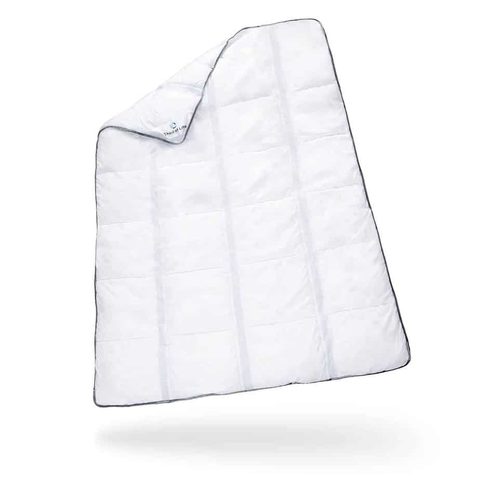
AERO Active-Clima All-Season Blanket
From Third of Life: a pillow filled with polyester fiber and the brand's proprietary Aerelle fiber, with a microfiber cover; machine washable at 40 °C.
View DuvetExclusive Fiber Pillow
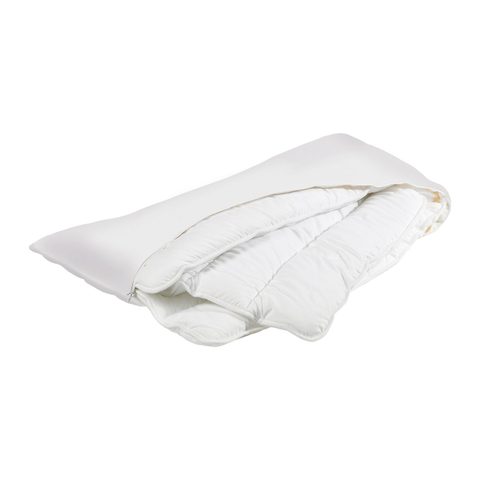
From Traumina: Functional polyester fabric, free of animal-derived ingredients, washable at 60 °C, and dryer-safe.
View Pillows
Other Fillings
Conclusion
Down is softer and lighter than feathers and provides better insulation; according to Öko-Test, how warm a duvet keeps you depends primarily on the air it traps. The label specifies the percentage of down and feathers. Certifications such as RDS or Downpass provide assurance regarding the origin, whereas the phrase “from dead animals” alone does not. If you sweat a lot, choose a different filling.
In the store, you'll find all down pillows and down comforters organized by category.
Frequently Asked Questions
How long do down products last?
According to Öko-Test, you should replace down pillows and comforters about every eight years. The down can break down and provide less warmth, Stiftung Warentest replied to a reader, but that doesn’t have to be the case: A down comforter can be refurbished and refilled with new down.
What does “Class I” mean on the label?
Class I, also known as “new,” refers to the feathers of waterfowl—that is, geese or ducks—containing less than 5% other components. This includes, for example, fiber fragments exceeding the permitted amount and feathers from landfowl; if the percentage is between 5% and 15%, it is classified as Class II. The species is also listed on the label: “Goose” means at least 70% goose feathers, and “pure goose” means at least 90%. This is how the IDFL testing laboratory summarizes the rules.
Does a pesticide label say anything about animal welfare?
According to OEKO-TEX, the OEKO-TEX Standard 100 is a label for textiles that have been tested for harmful substances; its description makes no mention of animal welfare. For the Rubin down comforter, the product page states that both the cover and the filling have been tested according to this standard. The RDS and Downpass certifications indicate the origin of the down.

Author
Sources
- Stiftung Warentest: Down Comforters, Problems with the Cover and Filling, and the Related Press Release (2020): Down and Feathers, Washing, Origin
- Stiftung Warentest: A Closer Look at Down and Feathers (2004): The Label According to DIN EN 12934
- Stiftung Warentest: Duvets Put to the Test: Sweating, Heat Ratings
- Öko-Test: Choosing the Right Duvet—Down, Feathers, or Wool: Warmth, Moisture, Dust Mites, Care
- IDFL: Europe Down & Feather Products Labeling, New EN Fill Power Standard, and Evaluation of Conditioning Methods: Labeling, Classes, and Fill Power According to EN Standards
- EN 12130:2018, Feathers and Down: Determination of Fill Power (Preview from the Slovak Standards Institute): Name and Purpose of the Test
- Hong Kong Consumer Council: Duvets (2025): Down Content, Fill Power, Washing
- Wölfling, Classen, Gerhardts (Hohenstein): Communications in Development and Assembling of Textile Products 1:39, 2020: 18 Blankets on the Sweating Mannequin
- EFSA: Welfare Implications of Collecting Feathers from Live Geese and the Scientific Opinion (2010): Collecting and Plucking Feathers from Live Geese
- Animal Welfare Ordinance (SR 455.1), Art. 20: Domestic Poultry
- Kassensturz: Animal Cruelty in Duvets (2017): Imports “from dead animals,” Downpass
- Textile Exchange: Responsible Down Standard and Downpass Standard 2022: What the Labels Require
- Siebers et al.: Permeability of synthetic and feather pillows (Clin Exp Allergy 2004), Rains et al.: Mite allergens on new synthetic and feather pillows (Clin Exp Allergy 1999), and Aykut: Goose down and wool pillows (Syst Appl Acarol 2021): Mites and down pillows
- aha! Swiss Allergy Center: Dust Mite Allergy and 10 Tips for Dealing with Dust Mites: Bedding and Laundry
- OEKO-TEX: Standard 100: What the Label Tests
- Hans Kruchen: Rubin Down Comforter, Rubin Pillow, and Jade Pillow: Information from the product pages in the Mara Vital online store
- Traumina: Plume Organic Down Pillow and Exclusive Fiber Pillow; Third of Life: AERO Active-Clima All-Season Comforter: Information from the product pages in the Mara Vital store
- Mara Vital: Camel Hair Blankets and Pillows, Alpaca Blankets and Pillows: Product Information
Consulting
If you have any questions or would like advice about our products, you can contact us directly at any time.
- Phone 041 440 86 86
- Email info@mara-vital.ch
- WhatsApp 079 841 86 86
Read more
-

Alpaca
Animal hair from the Andes for blankets and pillows.
-
kapok
The plant fiber for blankets and pillows.
-

Mattress Firmness Level
Read the hardness levels and match them to the model.
-
XXL Mattresses
Plan for extra length and width: sleeping surface, distance to the headboard, and the distance to the installation site.


