
Mara Vital Guidebook
Which mattress is really best for side sleepers?
There is no single "best" type of mattress for side sleepers. The key is to ensure that the shoulders and hips have enough room, while the waist and torso remain firmly supported.

In short
- Don't base your purchase on the material. Cold foam, gel foam, latex, and pocket spring cores can all work well if the specific construction suits you.
- H2 or H3 isn't the answer. The firmness level helps with the initial selection. The actual sleeping experience is what matters.
- Check the shoulders, waist, and pelvis separately. The shoulders and pelvis need space, while the core needs contact and support.
- Don't try to solve health complaints with marketing. Choosing a mattress is a decision about comfort and support, not a diagnosis or treatment.
As a side sleeper, how should I position myself on the mattress?
The body should not be balancing on a hard surface, but it should not sink into a soft hollow either.
First check the shoulder, then the pelvis, and finally the waist. This is easier to assess than an abstract measure of firmness.
Ideally, the head and neck form a straight line with the spine, the shoulder can sink in gently without sagging, and the pelvis remains stably supported.
Sleeping on one's side is the most common sleeping position among adults: According to a Danish study of 664 working adults, it accounted for just over 54 percent of the time spent in bed.

- Shoulder: It should give way without a hard edge pressing against it or the shoulder sagging downward.
- Waist: The center of the body should remain in contact with the garment. A noticeable gap or excessive sagging indicates that the fit is incorrect.
- Pelvis: The pelvis is allowed to sink in a controlled manner, but remains stable and level with the torso.
What does my body type need when sleeping on my side?
It varies depending on body type: Broad shoulders need to be able to sink in deeply enough, while a body with a large stomach tends to need more support at the waist. That’s how Stiftung Warentest describes it; the organization tests every mattress against seven body types.
| Build | That's what matters | Check this when you try it out |
|---|---|---|
| Broad shoulders | The shoulders must be able to sink down far enough. | The shoulder gives way without any hard edges pressing against it. |
| Big Belly | More support around the waist. | The core maintains contact without any noticeable gap. |
| Large and heavy | Clearly defined zones can help, but they are no guarantee. | The structure yields and provides support in just the right places. |
Based on a study of 25 men lying on their sides, the authors state that body-contoured zoning is the more appropriate choice for heavier men with pronounced body contours.
What firmness level is best for side sleepers?
There is no single firmness level that works for all side sleepers. According to Stiftung Warentest, how well a mattress provides support does not depend on its firmness: a soft mattress can support the spine just as well as a firm one. You should therefore choose the firmness based on how comfortable it feels when you lie on it.
Don't rely on the label: According to Stiftung Warentest, the firmness rating provided by the manufacturer often differs from the actual measurement. According to Stiftung Warentest, a mattress with two sides of different firmness increases the chance of finding the right firmness even without trying it out first.
The firmness level is a guideline, not a one-size-fits-all answer. The key is whether your shoulders and pelvis sink in properly and your core remains stable.
Cold foam, gel foam, latex, and pocket spring cores can work well for side sleepers. What matters is how the specific construction supports the shoulders, pelvis, and core.
| During testing | A good sign | Warning signal |
|---|---|---|
| Shoulder | It can give way without forming a sharp crease. | The shoulder is visibly raised. |
| Basin | It descends in a controlled manner. | The pelvis is significantly lower than the torso. |
| Waist | Contact and support will continue. | A noticeable hollow or deep sag. |
| Rotate | Changing positions feels easy. | You feel trapped in a hollow. |
Read more in the guide

Mattress Firmness Level
Read the hardness levels and match them to the model.
What role does the pillow play?
For side sleepers, the pillow should fill the space between the head and shoulder without pushing the head significantly upward or downward.
The right height depends on your shoulder width, how much you sink into the mattress, and the compression of the pillow. If it’s too low, your head will tilt downward; if it’s too high, it will tilt upward. In either case, your spine may bend unnaturally. Therefore, check the alignment of your head and neck while lying on your side in your normal sleeping position.
Guide Note: Here, we're just explaining why the pillow is included in the mattress test. You can find suitable pillows in the " Side Sleeper Pillows" category.

As a side sleeper, how do I test a mattress?
Four steps are enough as an initial filter.
- Test it in your usual side-sleeping position. Don't just try sitting on it, and don't just lie on your back if you mostly sleep on your side.
- Assess the shoulder and pelvis separately. Both areas should be able to give way without forming a pressure ridge or a deep hollow.
- Check your core. Your waist and torso should remain in contact and not drop noticeably.
- Everyday use instead of a 30-second first impression. If possible, test it over several nights and only then compare price, materials, and warranty.
After a few nights, a mattress may turn out to be unsuitable; Stiftung Warentest therefore advises arranging a return with the retailer. On the Mara Vital website, the product pages for the Geltech Deluxe and the Sleep Balance TFK list a 100-night trial period.
As a side sleeper, how do I interpret a mattress review?
Read the rating for the side sleeping position, specifically for the body type that most closely matches your own. Stiftung Warentest rates the sleeping comfort separately for each of its seven body types in both the side and back sleeping positions.
The seven body types represent height, body shape, and weight distribution, regardless of gender, and, according to the foundation, account for about two-thirds of the population in Germany. If you can’t clearly identify with one type, use the two types that are closest to yours as a guide.
According to Stiftung Warentest, an expensive mattress isn't automatically a good one. The test results themselves are available for a fee; we do not reproduce any of them here.
Which mattress is best for which type of side sleeper?
Once you've carefully assessed your shoulders, hips, and waist, you can narrow down your choices more effectively. These three models represent different approaches: conforming gel foam, varying levels of firmness, or natural latex on a pocket-spring core.
You can also narrow down your selection using the mattress finder or try out the models in the showroom.
To go with it
- All Side-Sleeper Mattresses
Here's an overview of the entire category, in case you want to compare them yourself.
 Geltech Deluxe
Gel foam topper and pocket spring core, if you're looking for a softer, more contouring sleeping experience.
- Sleep Balance TFK
Reversible with H2/H3 or H3/H4 if you want to remain flexible regarding firmness.
- In kind T-1000
A natural latex topper on a pocket spring core, when natural materials are the priority.
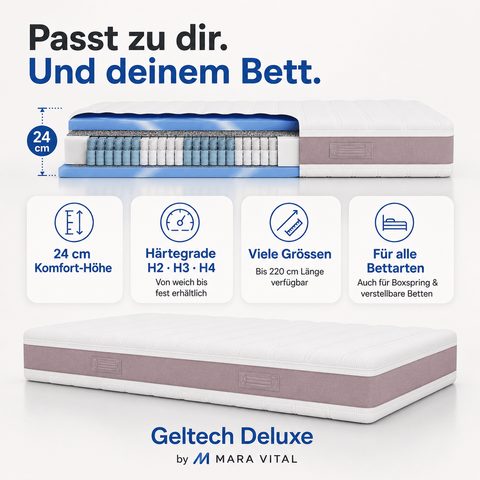 Geltech Deluxe
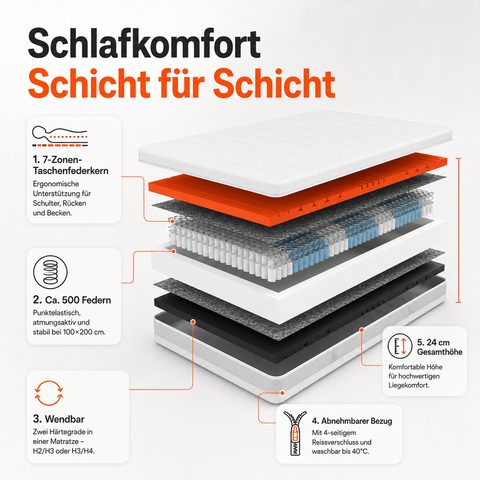 Sleep Balance TFK
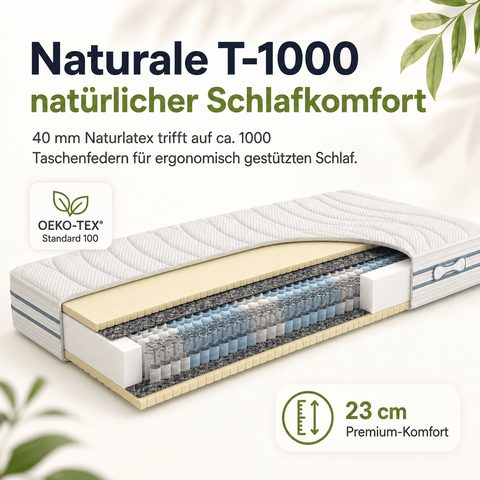 In kind
Will a slatted frame or mattress topper help before I buy a new one?
It depends on the mattress: If visible indentations remain, it's time for a new one. You can make some adjustments to the base and the mattress topper.
On the RA 400 slatted base, five slats in the shoulder zone can be flipped over; this changes how deeply the shoulders sink into the mattress. Sliders adjust the firmness in the lower back and pelvic areas. A topper adds an extra layer to the mattress: in the case of the Top Hybrid Plus, it features a 7-zone hybrid foam core.
Only the test in your normal side-lying position will show whether this is enough for you. We haven't read any studies on this; the information comes from our product pages.
To go with it
- RA 400 Slatted Base, Non-Adjustable
28 beech slats in three zones, five of which are in the shoulder zone for turning over.
- Topper Top Hybrid Plus
7-zone hybrid foam core; the cover is machine washable at 60 °C.
 RA 400 Slatted Base, Non-Adjustable
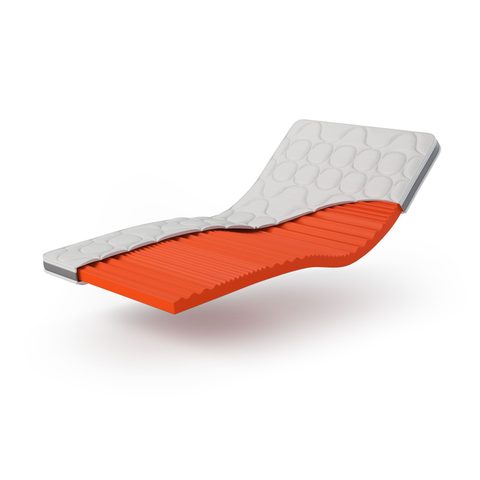 Topper Top Hybrid Plus
Conclusion
For side sleepers, it’s the fit that matters—not the material or the label indicating firmness: the shoulders and hips need space, while the core needs contact and support. Test the mattress in your usual side-sleeping position and, if possible, over several nights. Persistent or severe discomfort should be evaluated by a doctor.
Frequently Asked Questions
Do side sleepers really need a 7-zone mattress?
No. Stiftung Warentest measures the zones of a mattress but does not rate them: what matters is how well the mattress provides support. The key factor is whether the specific design yields and provides support in the right places based on your height. The “Body Type” section explains who might benefit from distinct zones.
Is cold foam or pocket spring better for side sleepers?
Neither is inherently better; both can work for side sleepers. Stiftung Warentest describes the differences as follows: A pocket-coil mattress yields only where pressure is applied; coil mattresses tend to be cooler, while foam and latex are warmer. Cold foam is the higher-quality type of polyurethane foam.
Is gel foam generally the best solution?
No. Cold foam, latex, and pocket-spring cores can also be good choices. The specific construction is more important than the material label.
What should you do if you have shoulder or hip pain?
A suitable mattress can provide greater comfort. In a review of 47 studies, medium-firm mattresses most often performed better than very firm or very soft ones; the summary does not list shoulder or hip pain as an outcome that was examined. Persistent or severe pain should be evaluated by a doctor.

Author
Sources
- Leilnahari et al.: Spine alignment in men during the lateral sleeping position. BioMedical Engineering OnLine 10:103, 2011. (PubMed) The measurement on which the section on shoulder and pelvic sinking in the lateral position is based.
- Kovacs et al.: Effect of mattress firmness on chronic nonspecific low back pain. The Lancet 362:1599, 2003. (PubMed) The randomized study that supports the recommendation for medium-firm mattresses; it pertains to nonspecific back pain, not a specific diagnosis.
- Radwan et al.: Effect of different mattress designs on promoting sleep quality, pain reduction, and spinal alignment. Sleep Health 1(4), 2015. (PubMed) The systematic review of controlled studies that prompted caution regarding blanket recommendations on mattress firmness.
- Stiftung Warentest: Mattresses Put to the Test. Independent test results on firmness and comfort across different manufacturers.
- Stiftung Warentest: The Seven Body Types (2026): Body Types, Ratings for Side and Back Sleeping Positions
- Stiftung Warentest: What to Look for When Buying a Mattress (2026): Firmness Ratings, Two Sleeping Sides, Returns, Zones, Price
- Stiftung Warentest: Latex, Spring Core, Foam (2026): A Comparison of Mattress Types
- Skarpsno et al.: *Nature and Science of Sleep*, 2017 (Abstract): How Much Time Adults Spend in Bed Lying on Their Side
- Caggiari et al.: Journal of Orthopaedics and Traumatology, 2021 (Abstract): Review of 39 studies on medium-firm mattresses
- The Impact of Mattresses on Lifestyle and Back Pain. Journal of Orthopaedics and Traumatology 27(1):53, 2026 (Abstract): A review of 47 studies on mattresses and back pain
- Mara Vital: Geltech Deluxe: Information About Our Product
- Mara Vital: Sleep Balance TFK: Information about the company's own product
- Mara Vital: Naturale T-1000: Product Information
- Mara Vital: RA 400 Slatted Base: Product Specifications
- Mara Vital: Topper Top Hybrid Plus: Information About Our Product
CONSULTING
If you have any questions or would like advice about our products, you can contact us directly at any time.
- Phone 041 440 86 86
- Email info@mara-vital.ch
- WhatsApp 079 841 86 86


