
Mattress Firmness Levels: What H2, H3, and H4 Really Mean
Even in Switzerland, mattress firmness ratings such as H2, H3, or H4 are not standardized across all manufacturers: they rank the different versions of a model from soft to firm. That’s why you should first choose the model, then its firmness level, and make your final decision based on the actual product.

In short
- First the model, then the number. H2, H3, and H4 denote the variants within a series: Compare them within the same model, not across different manufacturers.
- Use the model's weight range. When a model specifies weight ranges—such as the Boxspring Comfort—they quickly narrow down your options.
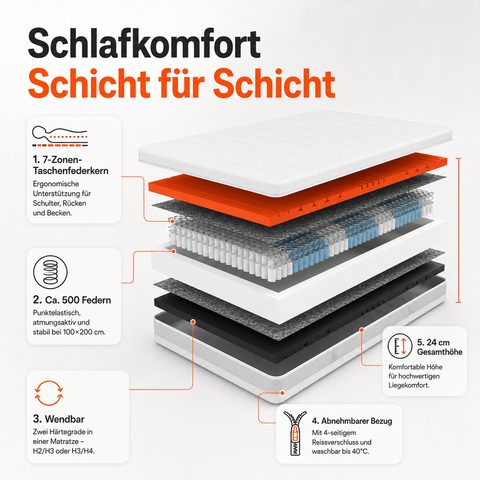
- Two sides, two levels of firmness. The reversible Sleep Balance TFK has two sides with different levels of firmness; with this partner mattress, each side of the bed has its own level of firmness.
- Trying it out is what matters. You can try it out in the showroom, and at home you can sleep on it for up to 100 days to test it out—and if you don't like it, you can return the mattress for free.
What do H2, H3, and H4 mean when it comes to mattresses?
They classify the variants of a model: H2 is the softer variant, H3 the medium variant, and H4 the firmer variant within a series.
The number is primarily a guide within a product family. It only becomes problematic when a model-specific label is treated as a general weight rule for every mattress.
- H2: The softer version within a series.
- H3: the medium or medium-firm option within a series. An H3 is not automatically the same firmness across different manufacturers.
- H4: the sturdier version within a series.
Even within the same store, the same number doesn't mean the same thing everywhere: For the Geltech Deluxe, H3 stands for "Medium," while for the Brinkhaus Como TTFK, according to the options and description, it stands for "Firm"—there, H2 is the medium option.
Two mattresses labeled H3 can therefore feel completely different: on one, the body lies almost on top, while on the other, it sinks in deeper. Only the model specifies what H3 means.
Is there a firmness rating chart for all mattresses?
No: There is no universally applicable correlation between firmness level and body weight, and manufacturers' firmness ratings often differ from actual measurements.
While EN 1957 does provide a standardized testing method for mattress firmness, this laboratory evaluation is not the same as the H2/H3/H4 designations found in stores: According to the standard, the measured firmness is not related to comfort or quality, and a test result applies only to the specific item tested.
A 2020 test by Stiftung Warentest shows what this means when shopping: Eight manufacturers listed their products as H3, but the test results showed four were soft, three were medium, and one was hard. Although there is a standard for measurement, many manufacturers label their products at their own discretion. The “Kassensturz” program also noted that labels such as “soft,” “medium,” or “hard” do not follow a standardized system.
The TÜV Association, on the other hand, refers to the firmness levels as standardized and assigns body weights to the levels ranging from H1 (very soft) to H5 (very firm). The 2020 measurements do not support such a table for all models. Even rules of thumb such as “height minus 100” are not based on any standard: EN 1957 and ISO 23769 describe test procedures, not body weight classifications.
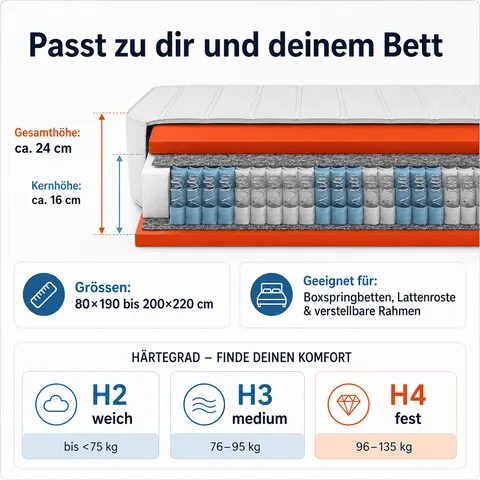
There is only one correct table for a specific model. For the current Boxspring Comfort, Mara Vital lists three firmness levels with model-specific weight ranges:
| Hardness | Weight range | Comfort while lying down |
|---|---|---|
| H2 | up to about 75 kg | soft |
| H3 | approx. 76 to 95 kg | medium |
| H4 | approx. 96 to 135 kg | firm |
According to the product page, your sleeping position and preferences can influence your choice. If you compare a different mattress later, be sure to read its firmness rating description again and don't apply the Boxspring Comfort ratings to another series.
If you weigh more than what this chart covers, the model’s weight limit applies: According to the product page, the Massive Deluxe can support up to 150 kg in the H4 configuration. Distinct sleeping zones can help large, heavy people sleep on their sides, but they don’t guarantee anything.
To go with it

Comfort Box Spring
Three firmness levels with published weight ranges: the model shown in this table.
View Mattress
H2 or H3, H3 or H4: How do you choose between two options?
Go with both versions of the same model, especially if you're close to the upper or lower limit of the weight range.
Whether someone prefers to sink in deeply or sleeps better on a firm surface is a matter of personal preference: Firmness can make a big difference in terms of comfort.
- Close to the limit: Try both variations in your usual sleeping position, roll over, sit up, and lie back down.
- Do you prefer a softer or firmer mattress? Choose based on how it feels when you lie on it, not on the number.
- No need to test it out: A mattress with two sides of different firmness increases your chances of finding the right firmness.
To go with it
Sleep Balance TFK
Reversible with H2/H3 or H3/H4 if you're torn between two options.
View Mattress
How do sleeping position and body type affect the firmness level?
You can change your choice within a single model: Stiftung Warentest recommends letting your body type, preferred sleeping position, and firmness preference be the deciding factors.
Weight alone does not define a person: The testers evaluate each mattress using seven body types that represent different heights, body shapes, and weight distributions, regardless of gender. Therefore, two people of the same weight may have different needs.
How you can tell if a particular model is right for you when you try it out depends on your sleeping position:
- Side-lying position: The spine should form as straight a line as possible; for this to happen, your shoulder must sink in low enough. If it remains elevated, this variation is too firm for you.
- Supine position: The spine retains its double-S shape, and the pelvis does not sink too low. If the midsection sags like in a hammock, the mattress is too soft.
- Prone position: The testers evaluate only the supine and side positions. In a laboratory study involving 17 healthy sleepers, participants slept worse in the prone and side positions on a sagging mattress than on one adjusted to their body weight: If the center of the body sags, the mattress is too soft.
There's no label to tell you which version will work for you—you'll have to try lying down on it to find out.
Read more in the guide

Mattress for Side Sleepers
Fit for the shoulders, hips, and waist.
Is a firmer mattress better for your back?
Not necessarily: According to Stiftung Warentest, firmness has no measurable impact on whether a mattress provides good support. “Firm” describes a characteristic, not a general quality rating.
Even an expensive base doesn't necessarily make a mattress a better fit: In their slatted-base tests, a good mattress often performed slightly better on a rigid particleboard surface than on the tested slatted base from the same manufacturer. Expensive spring-loaded bases sometimes made the sleeping experience worse, especially for back sleepers.
A soft mattress can provide just as much support for the spine as a firm one. Even in studies involving people with back pain, firm mattresses did not perform better: In a study of 313 adults with chronic nonspecific lower back pain, those on medium-firm mattresses had better outcomes after 90 days in terms of pain while in bed and daily functioning than those on firm mattresses. In a second study involving 141 patients, a waterbed and a foam mattress performed slightly better than a firm mattress, though the differences were small.
In studies like these, “medium-firm” does not mean H3: The study in *The Lancet* measured firmness on a scale developed by the European Committee for Standardization, which ranges from 1 (firmest) to 10 (softest). Their medium-firm mattresses scored 5.6, while the firm ones scored 2.3. The H ratings in the store cannot be directly equated with this scale.
Disclaimer: A mattress is not a treatment. The studies apply to the people who participated in them; persistent or severe back pain should be evaluated by a doctor. The guide “Mattresses for Back Pain” explains when you should see a doctor and what a mattress can do to help.
How do you choose the right firmness level?
First the model, then the firmness level: In five steps, you'll go from selecting a model to finding the right one for you.
- Start with a specific model. First, choose two or three mattresses that fit your bed. Only then should you compare firmness levels: These are listed on the product page under “Firmness Level”—for the Boxspring Comfort, they are Soft (H2), Medium (H3), and Firm (H4); for the Sleep Balance TFK, they are Firm/Medium (H4/H3) and Medium/Soft (H3/H2).
- Check the weight range for this model. Published weight ranges help narrow down your choices, as long as you're looking at the same model.
- Take your sleeping position and body type into account. To find out how to tell if a particular model is right for you when you try it out, see the section above titled “Sleeping Position and Body Type.”
- Compare similar variants. See the section above titled “H2 or H3, H3 or H4” for instructions.
- Make your decision based on the actual product. You can try it out in the showroom, and at home, according to the Terms and Conditions, you can test the mattress for up to 100 days and return it free of charge.
Bring your shortlist with you: In Volketswil and Dagmersellen, you can try out the models by appointment, and we’ll help you narrow down your choice based on the actual product. The Mattress Finder also provides an initial selection of models.
Can a mattress topper change the firmness level?
Make it softer, yes; save it, no: If your mattress is too hard or not soft enough, the right topper can make it more comfortable. It won’t fix the indentations in a worn-out mattress—in that case, the mattress needs to be replaced.
In tests conducted by European consumer organizations, many mattress toppers provided a softer feel, but their support was less impressive than their comfort. On a mattress that supports you well, a topper adds little benefit and may even have a negative effect—such as negating the mattress’s zoned support. You won’t know how it works on your mattress until you lie on it: Be sure to check the return policy before buying.
The " Mattress Protectors" guide explains the difference between a mattress topper and a mattress protector.
What happens if two people want to sleep in different spots?
Then each side of the bed gets its own option: For a double mattress, you can choose H2, H3, or H4 for each side.
For couples, having a shared H-number isn't the goal. What matters is what options the specific mattress system offers: With the Mara Vital Partner mattress, different H2/H3/H4 combinations can be selected for each side of the bed, and each side is configured according to the options of the chosen system. The available models are Massive Deluxe, Boxspring Comfort, Naturale T-1000, and Geltech Deluxe, all covered by a single, continuous cover.
To go with it
All Couple's Mattresses
The category with a selectable combination per page.
View categoryCouple's mattress
Two firmness levels in one mattress: H2, H3, or H4 on each side.
View Mattress
Conclusion
A firmness rating is a guide within a specific model, not a universal scale for all mattresses. First, choose the model, check its weight range, consider your sleeping position and body type, and make your decision based on the actual product. Firmer doesn’t necessarily mean better.
Frequently Asked Questions
Does "H3" mean the same thing for cold foam as it does for pocket spring mattresses?
Not automatically, because the cores respond differently: In a pocket spring core, each spring is housed in its own pocket and only compresses under the weight placed on it; with cold foam, the firmness depends on which part of the foam block the core is cut from.
Can I flip a mattress that has two sides with different firmness levels?
Yes, that's what it's designed for: If one side doesn't suit you, just use the other. The model description specifies how often you should turn it over for maintenance.

Author
Sources
- DIN EN 1957:2013-01, Furniture: Beds and Mattresses, Test Methods for Determining Functional Characteristics (DIN Media). The standardized test method provides the basis for specifications regarding firmness and durability; according to the standard, the measured firmness is not related to comfort or quality.
- Stiftung Warentest: Mattresses Put to the Test. Independent test results on firmness and comfort across different manufacturers.
- Mara Vital: Boxspring Comfort, selection guide on the product page. The weight specifications in the table above apply to this model and are taken from there.
- Mara Vital: Couple's Mattress, Configuration Options. The options covered in the section on two people sharing a bed.
- Stiftung Warentest: Only 5 out of 14 spring mattresses are rated "good" (press release, 2020): declared and measured firmness
- Stiftung Warentest: What to Look for When Buying a Mattress (2026): Firmness Ratings, Two Sleeping Sides, Returns
- Stiftung Warentest: The Seven Body Types (2026): Height, Body Shape, and Weight Distribution
- SRF Kassensturz: Even Inexpensive Mattresses Can Be Good (2013): Firmness Ratings Lack a Standardized System
- ISO 23769:2021, Furniture—Mattresses—Test methods for performance characteristics: durability, loss of height, and firmness
- TÜV Association: Healthy Sleep (Press Release, 2025): The Counterposition with Weight Ranges from H1 to H5
- Kovacs et al.: Effect of mattress firmness on chronic nonspecific low back pain. The Lancet 362:1599, 2003. (PubMed) This randomized study involving 313 adults and its firmness scale focuses on nonspecific back pain, not a specific diagnosis.
- Bergholdt et al.: Better Backs by Better Beds? *Spine* 33(7), 2008 (Abstract): Waterbeds, Foam Mattresses, and Firm Mattresses for Chronic Back Pain
- Mara Vital: Brinkhaus Como TTFK: Information About Our Own Product
- Mara Vital: Geltech Deluxe: Information About Our Product
- Mara Vital: Sleep Balance TFK: Information about the company's own product
- Mara Vital: Massive Deluxe: Product Information
- Stiftung Warentest: Latex, Spring, Foam—Which Mattress Type Are You? (2026): How Pocket Springs and Cold Foam Give Way
Consulting
If you have any questions or would like advice about our products, you can contact us directly at any time.
- Phone 041 440 86 86
- Email info@mara-vital.ch
- WhatsApp 079 841 86 86


