
Mara Vital Guidebook
Mattress Protectors: Molton, Waterproof, or Encasing?
An absorbent molton mattress protector is designed to handle sweat and everyday dirt. To protect against liquids, you’ll need a waterproof mattress protector with a barrier layer. If you have a dust mite allergy, allergy organizations recommend a mattress encasing that completely encloses the mattress.

In short
- Absorbent does not mean waterproof: Cotton molton absorbs moisture but does not act as a barrier against liquids.
- The barrier layer ensures waterproofing: Beneath the surface lies a membrane or coating—made of polyurethane in the case of Mara Vital’s protective pads.
- An encasing encloses the mattress: It completely wraps around it and fastens with a zipper. A mattress protector lies on top of it.
- Follow the care label when washing: Depending on the product, the maximum temperature is 60, 90, or 95 degrees. The number displayed in the wash tub is the maximum temperature.
Which mattress protector is right for which need?
The right mattress protector depends on what you want to protect your mattress from: sweat and everyday dirt, spills, or—if you have allergies—dust mites.
The consumer magazine K-Tipp notes: A molton pad or mattress protector protects the mattress. First, figure out what you need:
- Sweat and everyday dirt: A molton protector. The cotton absorbs moisture, and the protector goes in the wash. It is not waterproof.
- Beverages and other liquids: A waterproof mattress protector. Beneath its surface is a polyurethane barrier layer that keeps liquids away from the mattress.
- Children and Pets: This is also a waterproof mattress protector. The product pages list cribs, bedwetting, and pets as intended uses, and it is also available in sizes 60 × 120 and 70 × 140 cm.
- Incontinence: A protective product with a barrier layer and an absorbent layer on top, used as a pad, a liner, or an encasing. For more information, see the section on incontinence.
- House dust mite allergy: An encasing—that is, a cover that completely encloses the mattress. See the “Encasing” section for recommendations from allergy organizations.
The table shows what the four types of mattress protectors offer. It compares their construction, not individual products:
| Type | Absorbs moisture | Blocks liquid | Covered |
|---|---|---|---|
| Molton | Yes. | No. | The sleeping surface, and the sides as well, if using a fitted sheet. |
| Waterproof Protector | It depends on the surface. | Yes. | The sleeping surface. |
| Incontinence Pad | Yes, with absorbent fleece. | Yes. | A portion of the sleeping area. |
| Encasing | It depends on the product. | It depends on the product. | The entire mattress. |
To go with it
- Mattress protector
All Mara Vital protectors, pads, and encasings—if you want to compare them yourself.
Is an absorbent mattress protector also waterproof?
No: "Absorbent" means that the fabric absorbs moisture; "waterproof" means that no liquid passes through it. One does not imply the other.
The Mara Vital molton mattress protector makes all the difference: It’s made of 100% cotton and doesn’t have a plastic moisture barrier. According to the product page, it absorbs a lot of moisture but isn’t completely waterproof. The same goes for the molton fitted sheet, which is put on like a fitted sheet: It absorbs moisture and isn’t waterproof.
Molton is designed to handle sweat and everyday dirt: The protector absorbs moisture and goes in the laundry. If liquid is spilled, it can seep through the fabric and reach the mattress. To prevent this, a barrier layer is needed.
Molton and waterproofing are not mutually exclusive: There is molton that has a waterproof coating on the underside. In this case, “molton” refers to the surface, while the coating serves as the barrier layer.
You can find the Molton mattress protector and its dimensions in the " Size and Fastening" section.
What makes a mattress protector waterproof?
A barrier layer beneath the surface makes a mattress protector waterproof: in Mara Vital’s mattress protectors, this is a polyurethane membrane, layer, or coating.
Without a barrier layer, liquid can seep through the fabric and reach the mattress. With it, the liquid stays on top of the mattress until you remove the protector and wash it.
What Types There Are
Waterproof mattress protectors differ in terms of their surface and how much of the mattress they cover. Five styles from the Mara Vital line:
- Terry cloth over a membrane: A terry cloth surface with a polyurethane membrane underneath. The mattress protector lies on top of the mattress and is secured at the corners with elastic bands.
- Cotton with a polyurethane layer: cotton on top, a thin layer of polyurethane on the side facing the mattress, also with elastic bands at the four corners.
- Coated molton: Cotton molton with a waterproof coating on the underside.
- Pad with absorbent fleece: A smaller pad consisting of four layers: polyester on top and bottom, with an absorbent fleece and a layer of waterproof polyurethane in between. It covers part of the sleeping surface.
- Encasing with a membrane: A cover with a zipper all the way around, cotton terry cloth on top, and a polyurethane membrane on the underside. It encloses the mattress rather than lying on top of it.
Waterproof and breathable
A fabric can be both waterproof and breathable. Stiftung Warentest explains how this works for functional clothing: Hydrophilic membranes, such as those made of polyurethane, have no pores. Their molecules absorb water vapor and allow it to pass through the membrane, while water droplets cannot penetrate due to their size. Coatings are usually made of polyurethane and either have micropores through which water vapor escapes or function like a pore-free membrane.
Whether a fabric is waterproof and how much water vapor it allows to pass through are two separate properties, and there is a specific test for each. The ISO 811 standard describes a water-pressure test: it determines how well a fabric resists the penetration of water. The ISO 11092 standard describes how to measure a material’s resistance to heat and water vapor, including for films, coatings, and multilayer structures.
Several Mara Vital product pages describe their waterproof mattress protector as breathable. According to the product page, in the case of the waterproof encasing, it is the polyurethane membrane itself that is breathable. If the sleeping environment is important to you, check the construction when making a purchase: Which layer is the barrier layer, and which surface is on top of it?
Limitations of this guide: The term “waterproof” does not indicate whether you’ll sleep warmer or cooler on a waterproof mattress protector, and we haven’t found any measurements on this. The ISO 11092 standard also states that its test conditions do not simulate a specific comfort scenario. For information on how the layers of a bed affect temperature, see the guide “Sleep Cooler.”
All waterproof models are listed in the " Mattress Protectors" category; a selection of them, along with their dimensions, can be found in the " Size and Attachment" section.
When is an encasing the right product?
A mattress encasing is the right choice if you want the mattress to be completely enclosed, especially if you have a dust mite allergy: It completely covers the mattress and fastens with a zipper.
That's the difference between this and a mattress protector: A protector lies on top of the mattress and covers the sleeping surface, while a fitted molton sheet also covers the sides. Neither completely encloses the mattress.
According to the Federal Environment Agency, dust mites are found primarily in mattresses, comforters, and old upholstered furniture. aha! Allergy Center Switzerland recommends using dust mite-proof covers for mattresses, pillows, and comforters if you have a dust mite allergy, and identifies this as a key measure for reducing exposure. The German Allergy and Asthma Association also recommends covering the mattress with an allergen-proof cover.
According to the German Association of Allergists, clinical studies show that mattress encasings can significantly reduce allergen levels in the sleeping area and thus alleviate asthma symptoms.
The Association of German Allergists describes what is important when setting up the system:
- Completely enclosed: An encasing completely encloses the mattress. A fitted sheet is not sufficient for this.
- Seams and zippers: Small openings often occur in these areas. They must be covered so that no allergens can penetrate.
- Fabric: Woven, uncoated fabric is generally more breathable than nonwoven fabric. The polyurethane coating that was commonly used in the past is no longer necessary for a mite-proof cover.
- Laundry: An encasing must be washable at 60 degrees or higher.

You can check whether an encasing is leak-proof: The Hohenstein Testing Institute tests whether dust mite allergens can pass through the fabric, seams, and zippers. Ask for proof of this when you buy one.
According to the manufacturer, the allsana Encasing sensitive care from the Mara Vital line meets this standard: The Hohenstein Institute has tested and certified the material, seams, and zippers for resistance to dust mite allergens. You can find this information in the " Size and Fastening" section.
Not every encasing is waterproof. Mara Vital offers two designs: a cover made of finely woven microfiber, which its product page describes as mite-proof and a reliable protective barrier against dust mites and allergens, and a cover with terry cloth on top and a polyurethane membrane on the underside that blocks liquids. Both are listed in the “Size and Fastening” section.
What an encasing is not: It is one of several measures and is no substitute for a medical evaluation. According to aha! Allergy Center Switzerland, dust mites cannot be completely eliminated; the goal is to significantly reduce their presence.
What are the key considerations when choosing a mattress protector for incontinence?
When it comes to incontinence products, three things matter: the construction—consisting of an absorbent layer and a barrier layer—the area the product covers, and the temperature at which it can be washed.
- Construction: An absorbent layer absorbs the liquid, while the barrier layer underneath keeps it away from the mattress. The Mara Vital incontinence pad has four layers: polyester on top and bottom, with an absorbent nonwoven fabric and a layer of waterproof polyurethane in between.
- Covered Area: The pad is available in sizes ranging from 40 × 50 to 90 × 160 cm and protects the surface on which it rests. A waterproof mattress protector covers the sleeping surface, while a waterproof encasing encloses the mattress.
- Care: According to their product pages, Mara Vital’s mattress pad, terry cloth protector, and waterproof encasing can be washed at 90 or 95 °C and put in the dryer. Always follow the care label on the product.
The dimensions of the pad and the waterproof encasing are listed in the " Size and Attachment" section.
How do I wash a mattress protector?
Wash a mattress protector according to the instructions on its care label: The number in the washing machine drum indicates the maximum washing temperature in degrees Celsius, and you must not exceed it.

There is no single temperature that works for all protectors. The information provided on Mara Vital's product pages depends on the design:
- Cotton flannel: Machine washable up to 95 °C and dryer-safe. It will reach its final size after the first wash.
- Cotton with a polyurethane coating: Wash up to 60 °C; tumble dry on low heat; do not iron.
- Terry cloth over a membrane: 90 °C in the product page description, 95 °C in the product specifications; suitable for the dryer. In this case, the label on the product is the deciding factor.
- Encasing: According to their product pages, Mara Vital's mite-proof and waterproof covers are washable at temperatures up to 95 °C.
Aha! The Swiss Allergy Center recommends washing mite-proof covers according to the manufacturer's instructions, usually once or twice a year. The Association of German Allergists recommends washing them as infrequently as possible—twice a year—to ensure the material remains effective.
The bedding that goes over the mattress protector is washed more often: I see! The Swiss Allergy Center recommends washing it every week at a temperature of at least 60 degrees if you have a dust mite allergy.
We haven't found any documented figures on how often a protector that isn't an encasing should be washed. Wash it if it has absorbed any liquid, and otherwise as needed.
What size and mounting option are right for my mattress?
The mattress protector must fit the three dimensions of your mattress: width, length, and height. The way it is secured determines how much of the mattress it covers.
- Width and Length: For mattress protectors and encasings, the size specification refers to the mattress, not the dimensions of the protector. The protector itself may vary by a few centimeters, as noted on the product page for the cotton mattress protector with a polyurethane layer.
- Mattress height: According to their product pages, the mattress protectors with corner elastic bands fit mattresses up to 28 or 30 cm high, depending on the model, while the Molton fitted sheet fits mattresses up to 20 cm high. With an encasing, you choose the exact height: According to the product page, the dust-mite-proof cover has very little elasticity.
- Corner straps: Elastic straps at the four corners hold the mattress protector in place on the mattress. It covers the entire sleeping surface.
- Elastic all around: The molton fitted sheet is put on like a fitted sheet and covers the sides as well.
- Zipper: An encasing is pulled over the entire mattress and zipped closed all around.
The available sizes for each model are listed on its product page. Here are the six models covered in this guide:
To go with it
 Natural Molton Mattress Protector
For sweat and everyday dirt: 100% cotton molton without a moisture barrier, with four corner elastic straps for mattresses 15 to 30 cm high; washable up to 95 °C, according to the product page.
- Waterproof Mattress Protector
Liquid-resistant: Terry cloth over a polyurethane barrier layer, with elastic corners for mattresses up to 30 cm high. The product page lists 90 °C in the text and 95 °C in the specifications: Follow the care label.
- Waterproof incontinence pad
For incontinence: four layers of absorbent fleece and one layer of waterproof polyurethane, in sizes ranging from 40 × 50 to 90 × 160 cm; according to the product page, washable at up to 95 °C.
- Hypoallergenic Mattress Cover to Protect Against Dust Mites & Allergens
For those with a dust mite allergy: finely woven microfiber, described on the product page as mite-proof. Completely encloses the mattress and fastens with a zipper; fits mattresses 10 to 26 cm thick; machine washable up to 95 °C. According to the product page, it is dermatologically tested, rated “Very Good” by Dermatest, and tested for harmful substances in accordance with the OEKO-TEX Standard 100.
- allsana Encasing Mattress Cover, Sensitive Care
For house dust mite allergies, with certified testing: uncoated microfilament made of 70% polyester and 30% polyamide, with a zipper and cover flap. According to the product page, the Hohenstein Institute has tested the material and construction for resistance to dust mite allergens (Certificate MA-253119-Z). Available in heights from 12 to 30 cm; machine washable up to 95 °C.
- Encasing Mattress Cover for 20-cm-High Mattresses
All-around and waterproof: cotton terry cloth on top, a polyurethane membrane on the underside, and a zipper all the way around. According to the product page, it is washable up to 95 °C.
 Natural Molton Mattress Protector
 Waterproof Mattress Protector
 Waterproof incontinence pad
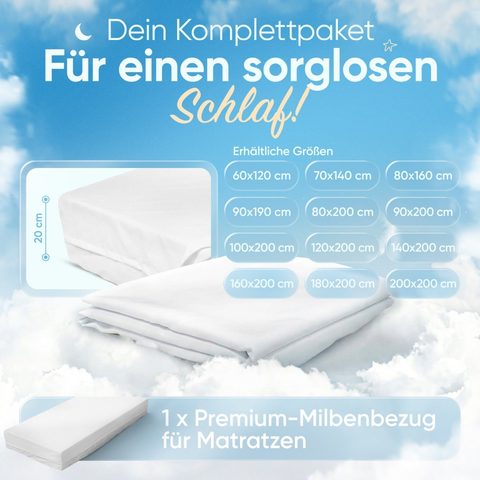 Hypoallergenic Mattress Cover to Protect Against Dust Mites & Allergens
 allsana Encasing Mattress Cover, Sensitive Care
 Encasing Mattress Cover for 20-cm-High Mattresses
Conclusion
Choose a mattress protector based on what you want it to protect against: molton for sweat and everyday dirt; a waterproof mattress protector with a barrier layer against liquids; or an encasing if the mattress needs to be completely enclosed due to a dust mite allergy. Absorbent does not mean the same thing as waterproof. Wash each protector according to its care label.
Frequently Asked Questions
Does the mattress protector go under or over the fitted sheet?
Under the fitted sheet: The mattress protector goes on the mattress, and the fitted sheet goes over it. The same applies to a mattress encasing. According to aha! Allergy Center Switzerland, it is pulled directly over the mattress, and the regular bedding goes over it.
Do I need two encasings for a double bed?
Yes, if the mattress cover is intended to address a dust mite allergy: The German Allergy and Asthma Association recommends covering all mattresses in double beds and in rooms where multiple people sleep. The Association of German Allergists also mentions the beds of partners and siblings in the same room.
Does health insurance cover an encasing?
According to aha! Allergy Center Switzerland, mite-proof covers are not covered under basic health insurance in Switzerland. Some supplemental insurance plans cover part of the cost: Check with your insurance provider.
Does a waterproof mattress protector make a crackling sound?
That depends on the product. According to their product pages, two terry cloth protectors from Mara Vital are soft, quiet, and don't rustle.

Author
Sources
- aha! Swiss Allergy Center: Dust mite allergy: dust mite-proof covers, bedding placed over the encasing, washing according to the manufacturer’s instructions, basic health insurance
- aha! Swiss Allergy Center: 10 Tips for Combating Dust Mites: Wash mattress covers once or twice a year; wash bedding every week at a temperature of at least 60 degrees
- Association of German Allergists: Quality Criteria for Encasings (Allergo Journal 2024): complete enclosure, seams and zippers, fabric, laundering, studies on allergen levels
- German Allergy and Asthma Association: Dust Mites: Mattress Covers, for All Mattresses in Double Beds
- Federal Environment Agency: Dust Mites: Where Dust Mites Live
- Hohenstein: Encasing Test Program (2024): Testing of Fabric, Seams, and Zippers
- allsana: sensitive care mattress cover: Hohenstein certification for mite allergen impermeability
- ISO 811:2018, Summary: Test for Resistance to Water Penetration
- ISO 11092:2026, Summary: Measurement of Resistance to Heat and Water Vapor
- GINETEX: Care symbols: the number in the washing tub indicates the maximum washing temperature
- K-Tipp: Vacuum or brush your mattress instead of beating it (2017): Use a molton pad or protective cover
- Stiftung Warentest: Membranes and Coatings (2005): How Polyurethane Membranes and Coatings Allow Water Vapor to Pass Through
- Mara Vital: Natural Molton Mattress Protector: Product Information
- Mara Vital: Molton Fitted Sheet Mattress Protector: Product Information
- Mara Vital: Waterproof Molton Mattress Protector: Product Specifications
- Mara Vital: Waterproof Mattress Protector: Product Information
- Mara Vital: Waterproof Terry Cloth Mattress Protector: Product Specifications
- Mara Vital: Waterproof Mattress Protector, Cotton: Product Specifications
- Mara Vital: Waterproof Incontinence Pad: Product Information
- Mara Vital: Encasing Mattress Cover for 20 cm Mattresses: Product Specifications
- Mara Vital: Hypoallergenic Mattress Cover Against Dust Mites & Allergens: Product Information
CONSULTING
If you have any questions or would like advice about our products, you can contact us directly at any time.
- Phone 041 440 86 86
- Email info@mara-vital.ch
- WhatsApp 079 841 86 86
Read more
-

Cleaning a Mattress
Step by step and spot by spot, if something does end up on the mattress.
-

Materials for Pillows and Blankets
How to care for hemp, kapok, Lyocell, virgin wool, Swiss stone pine, and camel hair.
-
All Guides and Frequently Asked Questions
Quick answers about mattresses, pillows, and blankets, plus detailed guides.


