
Kapok: The Plant Fiber Used as Filling for Duvets and Pillows
Kapok is the fiber from the fruit capsule of the tropical kapok tree. It is hollow inside, very light, and repels water. Mara Vital uses it to fill an all-season comforter—half kapok, half cotton—and a pillow whose height you can adjust yourself.

Kapok for Duvets and Pillows
| Feature | 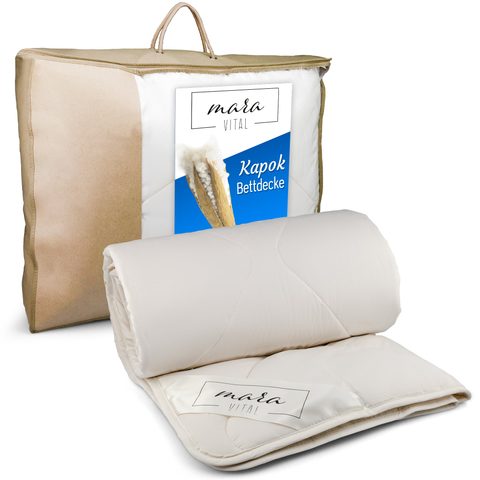 Kapok blanket | 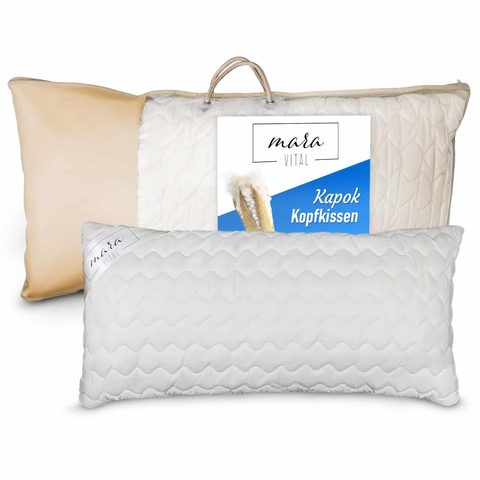 Kapok pillow |
|---|---|---|
| What It Is | Plant fiber from the fruit of the kapok tree | |
| Filling | 50% kapok and 50% cotton each | pure kapok or with cotton |
| Cover | Batiste, 100% organic cotton | Organic cotton with a zipper |
| Is there a | All-season blanket | Adjust height, change filling |
| Care | 40 °C | Cover: 60 °C |
| Sizes | 135 × 200 to 240 × 240 cm | 40 × 60 to 65 × 100 cm |
| In the Store | View Kapok Blanket | View kapok pillows |
What is kapok, and where does the fiber come from?
Kapok is a plant fiber derived from the fruit of the kapok tree, Ceiba pentandra. The tree grows in the tropics and is cultivated primarily in Southeast Asia, particularly in Indonesia and Thailand.
Its fruits are woody capsules 10 to 30 cm long. Inside are 120 to 175 dark seeds embedded in a mass of fine fibers called kapok. Unlike cotton fiber, it does not grow from the seed but from the inner wall of the fruit.
The ripe fruit is harvested before it bursts open, and then the loose seeds are beaten out of the fiber.
At Mara Vital, kapok is used in two products: The kapok blanket is filled half with organic kapok and half with organic cotton, while the kapok pillow is filled with pure kapok or a blend of kapok and cotton, both of which are organic. The product pages do not specify a country of origin.
What makes kapok a good filling material?
Above all, its hollow structure: Kapok fiber is a thin-walled tube 1 to 2 cm long that contains up to 80% air. This results in a large volume with comparatively little weight. Three additional properties are worth noting:
- Lightweight: Depending on the source, the fiber is six to eight times lighter than cotton.
- Water-repellent: A layer of wax on the fiber causes water to roll off. Kapok still absorbs moisture, though—more than synthetic fibers.
- Almost impossible to spin: In its natural form, kapok cannot be spun because its surface is too smooth. To make yarn and fabric, it is blended with cotton or other cellulose fibers.
According to a 2022 review article, kapok is most commonly used as filling for pillows and cushions. In pillows, the loose filling provides a customizable feel when lying down.
Is the kapok blanket right for you, and is it warm enough?
If you want a lightweight, plant-based blanket: Yes, according to its product page, the Mara Vital kapok blanket is an all-season blanket, and the store offers it only in various sizes, not as a summer or winter blanket.
No study has measured just how dry you sleep under a kapok blanket. The kapok blanket combines kapok with organic cotton, which can absorb moisture.
- Perfect if you like things light: Kapok is six to eight times lighter than cotton, and its main appeal is its light, fluffy feel.
- Perfect if you want to sleep vegan: The blanket and pillow contain only kapok and cotton, no animal hair.
- Probably not, if you like it firm: Kapok doesn't provide a very firm, compact feel when you lie down.
- Probably not if you have a dust mite allergy: Studies have found more dust mite allergens in kapok mattresses than in foam; blankets and pillows were not examined.
- It's unlikely to maintain the same thickness for many years: Under frequent compression, kapok loses its loft.
According to Stiftung Warentest, if you get cold easily, you need a blanket that provides more insulation, and if you sweat easily, you need one that provides less insulation. There is no standard definition for warmth ratings, and how warm or dry you sleep also depends on the room temperature, your bedding, and your personal comfort level. You can find a plant-based summer blanket made of hemp and lyocell in the Kapok, Lyocell, or Hemp section.
What was measured: We did not find any studies that tested a kapok blanket. In laboratory tests, loose, loosely packed kapok fiber, along with densely packed goose down, ranked among the five fillings with the best insulation properties. When tested on a sweating mannequin, jackets filled with kapok kept the mannequin just as warm as jackets filled with duck down.
What are the drawbacks of using kapok in bedding?
There are four reasons not to choose this fiber, depending on what matters most to you:
- Bausch: Under repeated pressure, the hollow fibers gradually collapse. In the lab, kapok lost more of its performance than down.
- Flammable: According to the PROTA plant handbook and World Agroforestry, untreated kapok fiber burns easily; however, there are methods to make it flame-retardant. According to its product page, the kapok blanket does not require any chemical treatment.
- Dust mites: One study found twice as many dust mites on kapok mattresses as on foam mattresses; in another study, dust mite allergens accumulated more quickly in kapok and synthetic fibers than in coconut fiber or foam. Blankets and pillows were not examined.
- Allergy: In a skin test conducted in Thailand, 30 out of 100 patients with allergic rhinitis reacted to kapok. It is unclear whether the reaction was to the fiber itself or to impurities.
What helps: For those with a dust mite allergy, the aha! Allergy Center Switzerland recommends dust-mite-proof covers for mattresses, pillows, and comforters, as well as pillowcases and duvet covers that are washed regularly at 60 °C.
Washing Kapok Blankets and Pillows: What Can Go in the Washer?
For the blanket, yes; for the pillow, only the cover: For kapok, refer to the information on the individual product page.
- Kapok blanket: Wash in the washing machine at 40 °C. Then tumble dry to help it regain its volume, and finish drying it in the open air. Air it out daily between washes.
- Kapok pillows: Wash the zippered pillowcase on the gentle cycle at 60 °C. A pillow filled with pure kapok is not washable; one filled with a blend of kapok and cotton should be washed gently by hand in lukewarm or cold water.
Same blend, two rules: The kapok and cotton filling in the blanket is machine-washable, but the product page specifies that the pillow should be hand-washed. Check the product page and care label before every wash.
What the lab found: When wet, kapok was easier to flatten than when dry and did not spring back as well. The material was not washed in these tests; instead, fiber samples were tested under pressure.
Kapok, Lyocell, or hemp: Which plant-based filling do you choose?
That depends mainly on how warm you want your blanket to be. All three are derived from plants: kapok and hemp are plant fibers—kapok comes from the fruit of the kapok tree and hemp from the bast of the hemp plant—while Lyocell is a cellulose fiber made from wood.
At Mara Vital, the kapok blanket is a year-round blanket. According to its name, the hemp blanket is also a year-round blanket, while the Lyocell blanket is a 400-gram summer blanket. In the shop, you simply choose the size for all three. The three side by side:
| Feature | kapok | Lyocell | Hemp |
|---|---|---|---|
| What It Is | Fiber from the kapok tree | Cellulose fiber from wood | Hemp Bast Fiber |
| Duvet Filling | Kapok and Cotton | 100% Lyocell | Hemp and Cotton |
| Duvets are available as | for the whole year | Summer blanket, 400 g | for the whole year |
| Duvet Care | 40 °C | up to 60 °C | 60 °C |
| Care Instructions for Pillows | Cover: 60 °C | up to 60 °C | Suitable for temperatures up to 60 °C |
Read more in the guide

What is Lyocell?
How the fiber is made from wood, what Tencel is, and how to wash it.
Other Fillings
Conclusion
Kapok is the hollow, very lightweight fiber from the fruit of the kapok tree. At Mara Vital, it’s used in an all-season comforter—half kapok, half cotton—and in a pillow with adjustable height. Follow the care instructions on the product label: wash the comforter at 40 °C; for the pillow, wash the cover at 60 °C and the mixed filling by hand. Kapok is a good choice if you want a light, plant-based sleeping experience, but it’s not recommended if you have a dust mite allergy or are looking for a heavy comforter.
The shop's selection of kapok products can be found under "Kapok Pillows " and " Kapok Blankets."
Frequently Asked Questions
Is kapok vegan?
According to the product pages, yes: Kapok blankets and kapok pillows contain only plant fibers—kapok and cotton. Be sure to check the full ingredient list for the version you've selected.
What is kapok used for besides in beds?
As an insulating material against heat and sound, and—because the fibers float in water—in life jackets. In research, kapok is also used as an oil absorbent: it absorbs oil and causes water to roll off.

Author
Sources
- PROTA: Ceiba pentandra (Duvall 2011) and PROSEA: Ceiba pentandra (Sahid, Zeven 2003): fruit, fiber, harvest, cultivation
- World Agroforestry: Useful Trees and Shrubs of Ethiopia, Ceiba pentandra, and Feedipedia: Kapok: Capsule, Seeds, Harvest
- Gómez-Maqueo, Gamboa-deBuen: *The Biology of the Genus Ceiba* (Plants 2022): what the fiber grows from, what it is used for
- Purnawati et al.: Physical and Chemical Properties of Kapok and Balsa Fibers (2018) and Lim, Huang (Chemosphere 2007): Length, Cavity, Wax
- Cárdenas-Oscanoa et al.: Insulation Boards Produced with Kapok Fiber (Global Challenges 2025): Air in the Fiber, Moisture
- Song, Chan, Yu (J Therm Anal Calorim 2014) and Wang: Kapok Coats and Traditional Down Coats (2010): Heat in the Laboratory and on the Mannequin
- Cui et al. (2009), Yan et al. (2013), and Yan, Wang, Xu (2014), *Textile Research Journal*: Kapok under pressure, wet and dry
- Visitsunthorn et al. (2010) and Abbott et al. (1981): Mites in kapok mattresses
- Pumhirun et al. (1997) and Kern, Kohn (1994): Kapok in skin testing; allergen status unclear
- Regulation (EU) No. 1007/2011, Annexes I and IX: the names of textile fibers, moisture allowances
- Stiftung Warentest: Duvets Put to the Test: Which Duvet Is Best for When You're Cold or Sweating, Heat Ratings
- aha! Swiss Allergy Center: Dust Mite Allergy: Bedding and Linens
- Mara Vital: Kapok Blankets and Kapok Pillows: Product Information
- Mara Vital: Lyocell Blankets, Lyocell Pillows, Hemp Blankets, and Hemp Pillows: Product Specifications
Consulting
If you have any questions or would like advice about our products, you can contact us directly at any time.
- Phone 041 440 86 86
- Email info@mara-vital.ch
- WhatsApp 079 841 86 86
Read more
-

Hemp
The natural fiber for blankets and pillows.
-
Down
Down or feathers: where they come from and how to wash a down comforter.
-
Mattress Protectors: Molton, Waterproof, or Encasing?
Which mattress protector is right for your needs.
-
Convenient exit height
From the floor to the top of the mattress: Measure accurately using a tape measure—it only takes a minute.


